





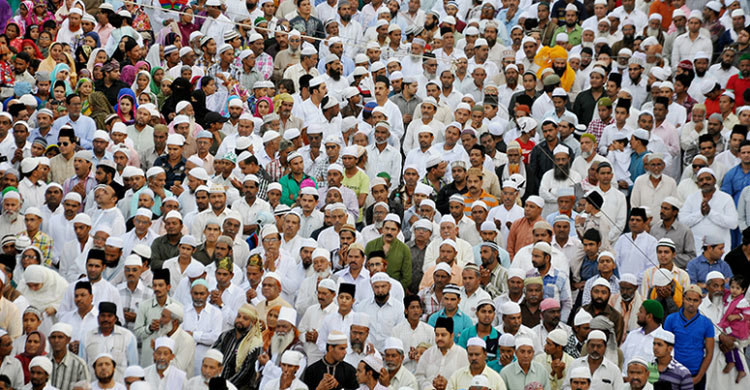
India is set to become the country with the largest Muslim population in the world within the next 25 years, according to recent research by the US-based Pew Research Center.
The Pew Research Center’s data reveals that in 2010, there were 1.6 billion (160 crore) Muslims worldwide, accounting for approximately 23% of the global population. The center’s analysis forecasts that the growth rate of the Muslim population will surpass that of the global population, with numbers expected to rise by 73%, reaching 2.8 billion (280 crore) in the coming years.
Pew Research also indicates that, except for Latin America and the Caribbean, the Muslim population will increase across all regions. By 2050, Muslims are projected to make up 10% of Europe’s total population.”
Currently, Indonesia has the largest Muslim population in the world. About 62% of the global Muslim population resides in the Asia-Pacific region, with the highest concentrations in Indonesia, India, Pakistan, Bangladesh, Iran, and Turkey.
India is home to nearly 400 million Muslims. The issue of the growing Muslim population has been a subject of debate in India since last year, which has since evolved into a topic of communal politics. This debate was sparked by the release of a report titled “Share of Religious Minorities: A Cross-Country Analysis” by the Prime Minister’s Economic Advisory Council.
The report highlights that between 1950 and 2015, the Hindu population in India decreased by 7.82%. In 1950, Hindus made up 84.68% of the country’s total population, but by 2015, this had fallen to 78.06%. In contrast, the Muslim population, which was 9.84% of the total in 1950, increased to 14.09% by 2015.
According to government reports, the Muslim population in India has increased by 43.15% compared to 1950.
This change in the ratio between the two major religious communities has sparked widespread concern among the Hindu majority in India. Fears that Muslims may soon surpass Hindus in numbers have contributed to the rise of communal tensions.
However, the statistics presented in the government report do not reflect the actual growth rate but instead highlight the shift in the proportion of Hindus and Muslims within the population.
Many analysts argue that despite the higher birth rate among Muslims, the existing gap between Hindu and Muslim populations is gradually widening. The notion that the Muslim population will soon surpass the Hindu population is deemed unlikely by experts.
LND/S H