





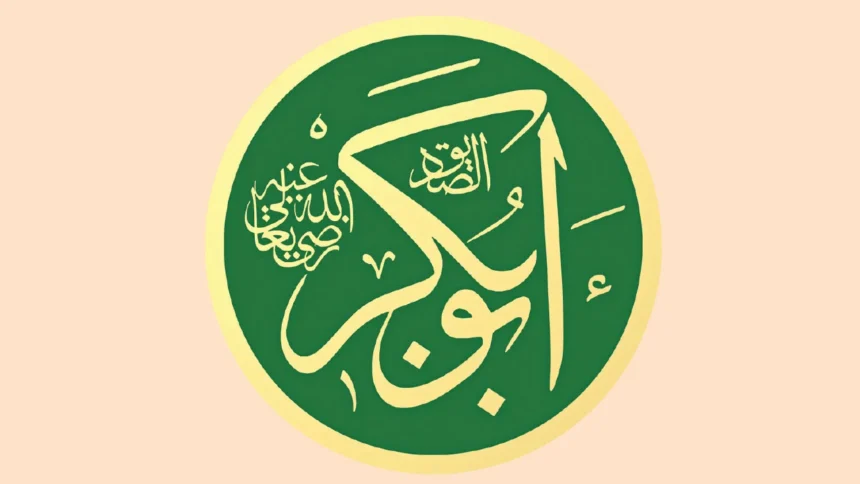
Abu Bakr Siddiq (RA), Islam’s first caliph, set an enduring benchmark for ethical governance through his humility, self-sacrifice, and unwavering commitment to justice—values often absent in today’s corridors of power.
In the annals of Islamic history, few figures stand as tall as Abu Bakr (RA), the closest companion of Prophet Muhammad (PBUH) and the first caliph of the Muslim Ummah. His leadership was marked not by wealth or ambition but by sincerity, transparency, and a deep sense of accountability to the people and to God.
From the earliest days of Islam, Abu Bakr (RA) demonstrated his devotion by embracing the faith without hesitation. According to authentic Hadith, his immediate acceptance of Islam serves as a rare example of unshakable faith, even among the earliest converts.
Known for his extraordinary generosity, Abu Bakr (RA) was never one to hold back when the Muslim community was in need. In one remarkable incident, he brought all his possessions to the Prophet (PBUH) in charity. When asked what he left behind for his family, he replied, “Allah and His Messenger,” underscoring his complete trust in divine provision.
After the Prophet’s passing, Abu Bakr (RA) was chosen to lead the Muslim nation. Despite assuming the highest position of power, he initially set out to return to the marketplace to sell cloth to earn a living. This powerful display of humility led his peers to grant him a modest stipend—equivalent to the allowance of an average immigrant from Makkah to Madinah.
His personal integrity was unmatched. When his wife managed to save a small sum from their daily needs, Abu Bakr (RA) instructed the state treasury to reduce his salary by that amount, insisting that he should not take more than what was necessary. His sense of responsibility was so deep that before his death, he requested his daughter Aisha (RA) to return the state-owned items he had used: a milk camel, a bowl, and a piece of cloth.
In an era where power often corrupts, Abu Bakr (RA)’s leadership offers a compelling counter-narrative—one rooted in humility, service, and moral clarity. His legacy serves not only as a beacon for Muslim leaders but as a universal blueprint for ethical statesmanship.
As political systems around the world grapple with issues of corruption and accountability, the example of Abu Bakr Siddiq (RA) remains profoundly relevant, reminding us that true leadership begins with character, not command.
** Special feature authored by Muhammad Baizid **
–
English News : https://www.libertynewsbd.com
বাংলা সংবাদ : https://www.bangla.libertynewsbd.com
X : https://www.x.com/libertynewsbd
Instagram : https://www.instagram.com/libertynewsbd/