





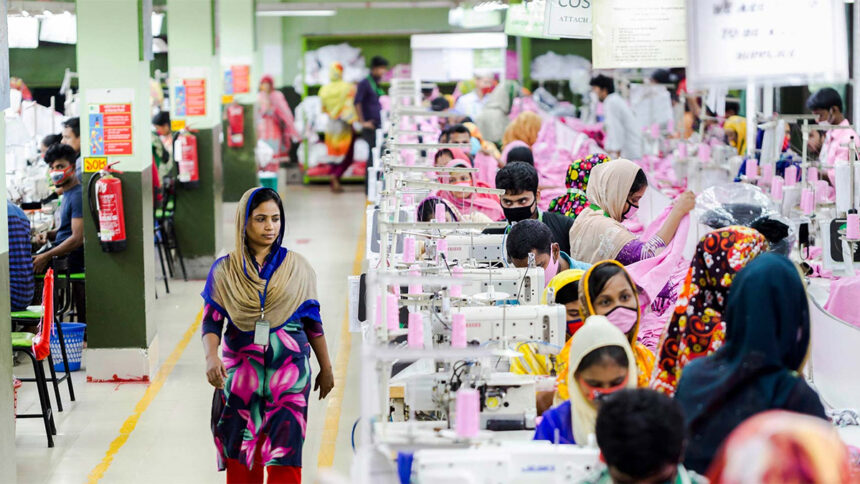
Bangladesh’s ready-made garment (RMG) exports grew by 8.84% in the 2024–25 fiscal year, reaching US$39.35 billion, according to the Export Promotion Bureau (EPB). The EPB’s country-wise export data reflects a continued positive trend in the sector.
The European Union remained Bangladesh’s largest RMG market, accounting for 50.10% of total exports, valued at $19.71 billion. Exports to the United States stood at $7.54 billion (19.18%), while the UK and Canada contributed $4.35 billion (11.05%) and $1.30 billion (3.31%), respectively.
Year-on-year growth was notable across major markets: EU 9.10%, USA 13.79%, Canada 12.07%, and UK 3.68%.
Germany topped EU destinations with $4.95 billion in exports, followed by Spain ($3.40 billion), France ($2.16 billion), the Netherlands ($2.09 billion), Poland ($1.70 billion), Italy ($1.54 billion), and Denmark ($1.04 billion). Strong growth was recorded in the Netherlands (21.21%), Sweden (16.41%), Poland (9.77%), and Germany (9.47%).
Exports to non-traditional markets rose by 5.61%, totalling $6.44 billion, and comprising 16.36% of the total RMG share. Japan, Australia, and India were key contributors. Growth rates included: Turkey 25.62%, India 17.39%, and Japan 9.13%.
However, exports to Russia, South Korea, the UAE, and Malaysia declined — a point of concern.
Within the RMG sector, knitwear exports grew by 9.73%, while woven garments increased by 7.82%.
Reflecting on the broader export outlook, Mohiuddin Rubel, former director of BGMEA and managing director of Bangladesh Apparel Exchange, said Bangladesh’s performance in traditional markets remains strong, accounting for 84% of total apparel exports. However, non-traditional markets remain underutilised, with only a 16% share.
Citing International Trade Centre (ITC) data, Rubel noted that the global apparel market reached around $500 billion in 2024, with $150 billion from non-traditional markets. Bangladesh holds a 6% share in that segment, indicating room for growth. Notably, in 2024, Bangladesh supplied 5.50% of Japan’s and 11.53% of Australia’s total apparel imports.
Stressing the need to focus on innovation and diversification to stay competitive, Rubel said, “Adapting to today’s dynamic environment requires exploring new markets and developing fresh products. It’s not just about pricing—sustainable competitive advantages are crucial to becoming the preferred choice for buyers. We must offer unique value that sets us apart from rival countries,” he said.
Rubel called for leveraging Bangladesh’s potential through innovation and strategic expansion to secure a stronger foothold in both traditional and emerging markets.
LND/NE
For 24/7 breaking news:
🌐 English News – www.libertynewsbd.com
🌐 বাংলা সংবাদ – bangla.libertynewsbd.com
📌 Facebook – www.facebook.com/libertynewsbd/
📌 Facebook (বাংলা) – www.facebook.com/libertynewsbangla/
📌 X (Twitter) – www.x.com/libertynewsbd
📌 Instagram – www.instagram.com/libertynewsbd
📌 YouTube – www.youtube.com/@LibertyNewsBD